
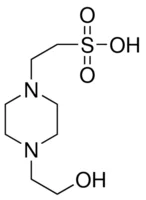
Description
Description
Hepesanhydrous Free-Flowing Redi-Dri ≥99.5% 1 Kg
Synonym: 4-(2-Hydroxyethyl)piperazine-1-ethanesulfonic acid, N-(2-Hydroxyethyl)piperazine-N′-(2-ethanesulfonic acid)
- CAS Number 7365-45-9
- Empirical Formula (Hill Notation) C8H18N2O4S
- Molecular Weight 238.30
- Beilstein/REAXYS Number 883043
- EC Number 230-907-9
- MDL number MFCD00006158
- PubChem Substance ID 329824215
- NACRES NA.25
| grade | Redi-Dri |
| anhydrous | |
| assay | ≥99.5% |
| quality | free-flowing |
| pH | 5.0-6.5 (25 °C, 238 g/L) |
| useful pH range | 6.8 – 8.2 |
| pKa (25 °C) | 7.5 |
| SMILES string | OCCN1CCN(CC1)CCS(O)(=O)=O |
| InChI | 1S/C8H18N2O4S/c11-7-5-9-1-3-10(4-2-9)6-8-15(12,13)14/h11H,1-8H2,(H,12,13,14) |
| InChI key | JKMHFZQWWAIEOD-UHFFFAOYSA-N |
General description
HEPES has been described as one of the best all-purpose buffers available for biological research. At biological pH, the molecule is zwitterionic, and is effective as a buffer at pH 6.8 to 8.2. HEPES has been used in a wide variety of applications, including tissue culture. It is commonly used to buffer cell culture media in air. HEPES finds its usage in in vitro experiments on Mg.
Application
HEPES has been used:
• In the novel vesicle-budding protocol as a component in stock solution and buffer solutions
• As a component in intracellular solution for the preparation of brain-slice recording
• As a component of wash buffer, elution buffer and desalting buffer during affinity protein purification
• To maintain the pH at 7 in thermal denaturation assay of purified protein
• In isocratic elution of protein using gel filtration
• Along with NaCl in sample preparation for EPR (Electron Paramagnetic Resonance) spectroscopy
Documents
Safety Data Sheet

Reviews
There are no reviews yet.