
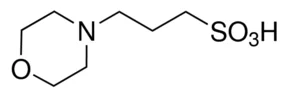
Description
Description
Mops ≥99.5% Titration 5 Kg
Synonym: 3-(N-Morpholino)propanesulfonic acid, 4-Morpholinepropanesulfonic acid
- CAS Number 1132-61-2
- Empirical Formula (Hill Notation) C7H15NO4S
- Molecular Weight 209.26
- Beilstein/REAXYS Number 1106776
- EC Number 214-478-5
- MDL number MFCD00006183
- PubChem Substance ID 24896628
- NACRES NA.25
| assay | ≥99.5% (titration) |
| pH | 2.5-4 (25 °C, 209 g/L) |
| useful pH range | 6.5 – 7.9 |
| pKa (25 °C) | 7.2 |
| λ | 33 % in H2O |
| Featured Industry | Diagnostic Assay Manufacturing |
| SMILES string | OS(=O)(=O)CCCN1CCOCC1 |
| InChI | 1S/C7H15NO4S/c9-13(10,11)7-1-2-8-3-5-12-6-4-8/h1-7H2,(H,9,10,11) |
| InChI key | DVLFYONBTKHTER-UHFFFAOYSA-N |
General description
3-(N-Morpholino)propane sulfonic acid (MOPS) is an N-substituted amino sulfonic acid with a morpholinic ring. MOPS is capable of buffering within a pH range of 6.5-7.9. MOPS is widely used in biological and biochemical studies due to its inert properties. It does not interact with any metal ions in solutions and has significant metal-buffer stability especially with copper (Cu), nickel (Ni), manganese (Mn), zinc (Zn), cobalt (Co) ions. MOPS buffer maintains the pH of the mammalian cell culture medium. MOPS functions to maintain pH in denaturing gel electrophoresis of RNA. MOPS can modify lipid interactions and influence the thickness and barrier properties of membranes. MOPS interacts with bovine serum albumin and stabilizes the protein. Hydrogen peroxide oxidizes MOPS slowly to N-oxide form.
Application
MOPS has been used as:
• a cell culture additive component in lentiviral particle production
• as a buffering agent in microbial growth medium and nuclei extraction buffer
Documents
Safety Data Sheet
Reviews
There are no reviews yet.